
Table of Contents
Perhaps you’ve been contemplating veneers for some time but feel uncertain about how to proceed. If so, you’re certainly not alone in your hesitation. Most individuals who ultimately pursue veneers spend considerable time, sometimes years, mentally preparing themselves before taking action. The encouraging news is that the entire process proves far simpler and more straightforward than it might appear from the outside, particularly once you become familiar with what each stage entails.
Key Takeaways
-
Veneers are custom-fabricated shells composed of porcelain or composite material that overlay the front surfaces of teeth to enhance color, form, length, and spacing.
-
The journey begins with a consultation phase, allowing you to gather information and explore your options before committing to treatment.
-
The majority of individuals are suitable candidates for veneers, provided their oral health is optimized and any existing dental concerns are resolved beforehand.
-
The complete treatment typically requires two to three appointments distributed over several weeks, with temporary restorations protecting your teeth between preparation and final placement.
-
Porcelain veneers often maintain their appearance for a decade or longer with proper maintenance, whereas composite versions provide a more economical option with a shorter functional timeframe.
Table of contents
- Key Takeaways
- Understanding Veneer Fundamentals
- Determining Your Candidacy
- The Initial Consultation Experience
- The Treatment Timeline
- Long-Term Veneer Care
- Making Your Decision
Understanding Veneer Fundamentals
Veneers represent ultra-thin, custom-manufactured coverings that bond to the front surface of your teeth. They are typically fabricated from porcelain, which replicates the visual qualities of natural tooth enamel with remarkable accuracy, or from composite resin, which offers greater affordability and frequently can be completed during a single appointment. Regardless of material choice, the fundamental objective remains consistent: to create a more refined, uniform, and aesthetically polished anterior smile.
Patient motivations for selecting veneers are diverse. Some individuals pursue them to brighten teeth that have become resistant to conventional whitening treatments. Others seek to eliminate minor gaps, reconstruct damaged tooth surfaces, or establish visual harmony among teeth of varying lengths. Veneers function primarily as an aesthetic overlay rather than modifying underlying tooth structure. They adhere to the tooth surface like a specialized cosmetic covering tailored exclusively for your smile.
Determining Your Candidacy
When you express interest in veneers, your dentist’s initial assessment addresses two fundamental questions: whether your mouth is prepared for treatment and whether your aspirations align with what veneers can realistically accomplish. Several factors typically influence this evaluation.
-
**Oral Health Foundation:**Existing cavities, periodontal disease, or substantial bite abnormalities typically require resolution before veneer placement can proceed.
-
**Nocturnal Grinding Habits:**Patients with bruxism may benefit from protective night guard recommendations to preserve veneer longevity.
-
**Enamel Adequacy:**Your dentist will evaluate whether sufficient healthy enamel remains to support veneer adhesion.
-
**Realistic Goal Setting:**Veneers deliver optimal results when designed to enhance existing smile characteristics rather than dramatically alter fundamental tooth anatomy.
-
**Professional Assessment:**An ethical cosmetic dentist will articulate precisely what veneers can and cannot accomplish for your particular dental situation.
The Initial Consultation Experience
Your initial appointment functions as an informational conversation rather than a clinical procedure. You will discuss your smile preferences and concerns, review examples of successful veneer outcomes, and explore visual representations of your potential results. Contemporary dental practices frequently employ digital imaging technology that generates realistic renderings of your post-treatment smile. This visualization often significantly increases patient confidence about moving forward with treatment.
This appointment also provides an ideal opportunity to address your questions comprehensively. How many veneers will you require? Should you select porcelain or composite? What timeline applies? How durable are veneers? A quality consultation leaves you feeling well-informed rather than pressured, with a transparent understanding of your available options and their respective implications.
The Treatment Timeline
The veneer placement procedure typically spans two to three appointments distributed across several weeks. During your initial treatment appointment, your dentist carefully contours the anterior tooth surfaces destined to receive veneers, obtains detailed impressions or digital scans, and applies temporary restorations to maintain appearance while your permanent veneers undergo fabrication in the dental laboratory.
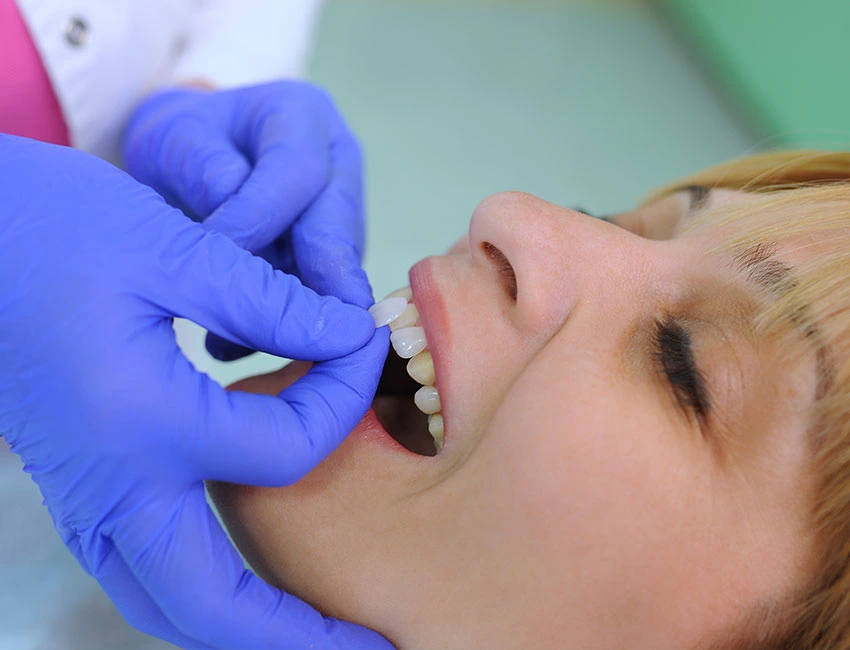
Throughout the interim period, your permanent veneers are meticulously crafted to achieve precise color, morphology, and dimensional specifications established through your collaborative consultation. At your final appointment, temporary restorations are removed, your completed veneers are tried in place for verification, minor adjustments are executed as needed, and the permanent restorations are bonded in position. Most patients express surprise at how comfortable and straightforward the entire process proves.
Long-Term Veneer Care
Veneer maintenance requires no specialized techniques beyond conventional oral hygiene practices. Continue your established brushing and flossing routine, and maintain your regular professional cleaning appointments, during which your dentist evaluates both the veneers and the surrounding periodontal tissues. Although porcelain veneers resist staining more effectively than natural enamel, prudent dietary choices regarding heavily pigmented beverages and tobacco products benefit long-term aesthetics.
With diligent maintenance, porcelain veneers commonly maintain their aesthetic appeal for a decade or more before replacement becomes necessary. Composite veneers typically require refreshing sooner, but offer simplified maintenance and reduced replacement costs. In either scenario, your daily care regimen mirrors the fundamental oral hygiene practices you already follow.
Making Your Decision
For most individuals considering veneers, the greatest challenge is not the treatment itself but rather the hesitation preceding the initial consultation. If you’ve been contemplating veneer treatment without knowing your next step, scheduling a consultation with an experienced cosmetic dentist represents your most productive action. Attending a consultation carries no obligation and typically provides clarity regarding your realistic options and treatment possibilities.
- If you want to learn more about veneers, visit our Veneers in Wildomar page or schedule a consultation.